
The Tale of the Horse-Breeder
547 Jataka Tales
36

The Tale of the Horse-Breeder

Buddha24Ekanipāta
Listen
In a past aeon, in the flourishing city of Varanasi, the Bodhisatta was born as a young Brahmin, endowed with keen intellect and noble virtues. He lived with his loving family in a modest dwelling within the city walls. His gentle demeanor and generous spirit endeared him to all who knew him. He was blessed with a wife as beautiful as a celestial nymph and five charming children. His life was one of profound peace and contentment. One day, while engrossed in the study of ancient scriptures beneath the shade of a great Sala tree in his garden, a gentle breeze rustled the leaves. As he pondered the wisdom of the texts, a thought arose in his mind, a seed of an idea that would soon blossom into a significant undertaking. He decided to embark on the noble profession of horse-breeding, a pursuit that required patience, keen observation, and a deep understanding of animal nature. He diligently acquired the finest mares and stallions, carefully selecting those with the most desirable qualities – strong build, spirited temperament, and impeccable lineage. He dedicated himself to their care, ensuring they were well-fed, exercised, and sheltered. His stable became renowned for the health and quality of its horses. Word of his exceptional breeding stock spread throughout the land, attracting buyers from far and wide. Among his most prized possessions was a magnificent stallion, a creature of unparalleled beauty and power. This horse, however, possessed a peculiar habit. Though otherwise well-behaved, it would occasionally let out a loud, startling neigh, startling anyone who happened to be near. The Bodhisatta, with his characteristic patience and insight, did not punish or discard the horse for this. Instead, he observed it closely, seeking to understand the reason behind its outburst. He noticed that the neigh often occurred when the horse sensed an impending danger or a significant change in its environment. It seemed to be a warning, a primal cry of awareness. The Bodhisatta, recognizing the horse's innate intelligence and sensitivity, began to train it differently. He would gently soothe it before it could neigh, or use the sound as an opportunity to teach it to respond to specific commands. His understanding and gentle handling of the horse yielded remarkable results. The stallion, while retaining its spirited nature, became even more responsive and obedient. Its warning neighs, once a source of alarm, were now interpreted by the Bodhisatta as valuable signals, allowing him to prepare for unforeseen circumstances, be it a sudden storm or the approach of unwelcome visitors. His other horses, observing the well-being and training of the stallion, also seemed to thrive, their own temperaments becoming more refined. One day, a great drought afflicted the land. The rivers ran dry, and the fields turned to dust. The people of Varanasi despaired, fearing for their survival. The Bodhisatta, however, had foreseen the possibility of such a disaster through the keen senses of his special stallion, whose unease had been palpable for weeks. He had, therefore, meticulously prepared by storing ample provisions of fodder and water, and had even dug a deep well on his property. When the drought reached its peak, and the city's water sources were depleted, the Bodhisatta opened his well and shared his stored fodder with the starving horses of the city, including those belonging to the king. His generosity and foresight saved countless animals and brought immense relief to the people. The king, witnessing this act of unparalleled compassion and wisdom, was deeply moved. He recognized the Bodhisatta not just as a skilled horse-breeder, but as a truly virtuous and sagacious individual. From that day forward, the Bodhisatta was held in even higher esteem. His wisdom, born from patient observation and understanding, had not only benefited his own household but had also served the entire community. He continued to live a life of quiet dignity and profound wisdom, his actions a testament to the power of gentle discipline and insightful perception.

— In-Article Ad —

💡Moral of the Story

The highest form of virtue is selfless compassion, willing to sacrifice for the well-being of others.

Perfection: Generosity (Dana Paramita), Compassion (Karuna Paramita)

— Ad Space (728x90) —

More Jataka Tales You May Enjoy

Sutasoma Jataka
305Catukkanipāta

Sutasoma Jataka

Sutasoma JatakaIn the ancient and prosperous kingdom of Pancala, there lived a wise and benevolent k...

💡 True strength lies in compassion, wisdom, and the ability to transform others through understanding, rather than through force or violence. Non-violence and empathy can overcome even the most formidable adversaries.

The King of the Elephants (Makhādeva Jātaka)
287Tikanipāta

The King of the Elephants (Makhādeva Jātaka)

The King of the Elephants (Makhādeva Jātaka) Long ago, in a lush forest teeming with life, a majesti...

💡 True leadership requires immense courage, self-sacrifice, and unwavering determination to protect and provide for one's followers, even in the face of insurmountable challenges.

Mūga-Pakṣa Jātaka
309Catukkanipāta

Mūga-Pakṣa Jātaka

The Silent SageIn the kingdom of Mithila, there lived a king named Vidhuratha. He was a just ruler, ...

💡 True wisdom is not always expressed through eloquent speech; profound understanding and inner peace can be conveyed through silence and action. Do not be swayed by superficial appearances or clever words; seek the deeper truths that lie beneath.
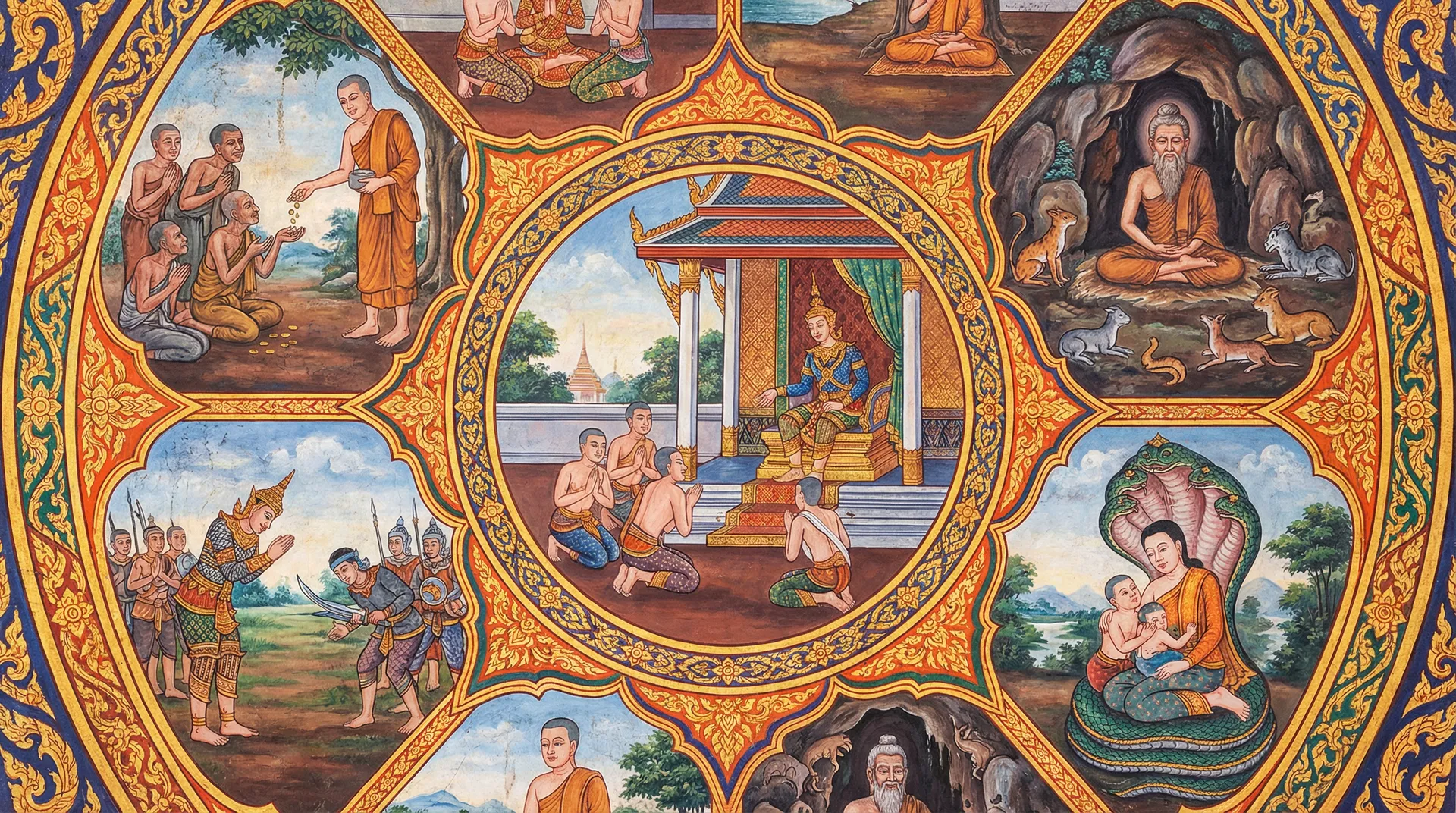
Sattubhatta Jataka
357Pañcakanipāta

Sattubhatta Jataka

Sattubhatta Jataka Long ago, in a time when gods and humans walked more closely, the great Bodhisatt...

💡 True wealth is not measured by possessions, but by generosity and the well-being of others. Greed leads to emptiness, while sharing brings true satisfaction and prosperity.

Mahādhammapāla Jātaka
374Pañcakanipāta

Mahādhammapāla Jātaka

Mahādhammapāla JātakaIn the verdant land of Kasi, where the sun cast a golden hue upon rolling hills...

💡 Deceptive gifts and false alliances often mask hidden agendas. True strength and victory are achieved through righteousness, wisdom, and genuine preparedness.

The Tortoise Who Saved His Companions (Nāga Jātaka)
288Tikanipāta

The Tortoise Who Saved His Companions (Nāga Jātaka)

The Tortoise Who Saved His Companions (Nāga Jātaka) In a time when the earth was a tapestry of vibra...

💡 True strength lies not in physical prowess, but in the wisdom and selfless courage to protect and guide others through adversity.

— Multiplex Ad —

This website uses cookies to improve your experience, analyze traffic, and display relevant advertisements. Privacy Policy